Saturday, October 24, 2015

Adv Tech Course - Module 10


Keynote for Mac is a a world-class presentation software that enables the online course instructor to create and share professional presentations with ease.  Of the numerous benefits of using the software to produce course multimedia, three items stand out as being its greatest strengths: Simplicity of use, powerful tools and effects, and cross-device and platform compatibility. These strengths lend to Keynote's versatility in how course instructors (and students) can use it to enhance the online learning environment.

Keynote is designed with simplicity. Its interface is streamlined, with the most-often used tools and options directly at the user's fingertips. Other features and functions are found in a "Format Panel", which automatically adjusts the options displayed based on the element selected in the presentation.  This organized functionality enhances workflow, making the construction of presentations efficient.  In addition, Keynote can export in different formats and share a presentation in seconds, be it to YouTube, through e-mail, or social media, enabling viewing on any device, including mobile.

Probably its most desirable feature for the online course instructor is just how easy it is to make and share a high-quality recording of a narrated (nor not) presentation. The recording can be edited, to include editing a slide that was already recorded, and can be exported in a number of formats, including QuickTime and HTML, making its inclusion in an online course a breeze.

In regards to powerful tools and effects, Keynote is packed with not only the typical format-editing options, but also eye-catching animations and transitions, all of which are categorized and arranged to make finding what you want quick and easy.  In addition, all format and enhancement editing can be previewed, allowing one to scroll through the variety of options to find that perfect one.

As for compatibility, Keynote works seamlessly between Mac and iOS devices, and can export, import and edit Microsoft PowerPoint, which means the course instructor, or students collaborating on a group project, are not hamstrung to working on a presentation from a certain device. In addition, since Keynote can connect with iCloud, export and share presentations to Google Drive, etc., students and instructors can access files and collaborate on assignments from anywhere, at any time.

The only limitation of the software that is worth mentioning is that to take full advantage of what Keynote can do for instructors and students, it is obviously beneficial to have an Apple device, be it a desktop, laptop, iPad, or even an iPhone. For example, although Keynote can export and import files to PowerPoint, most, not all, of the features, effects, animations, etc., added to a presentation by either program are maintained in the file conversions.

Finally, the ability to collaborate (student-student and instructor-student) with Keynote has already been mentioned as a use in the online classroom, but there are a number of other obvious uses for the software. For example, a course instructor can utilize Keynote's capabilities to create presentations that introduce a course or lesson and review key concepts. Furthermore, as was the case in making the video below, an online course instructor could use Keynote, in conjunction with screen capture and movie editing software, to make tutorials for assignments, exercises, and even for guidance to students on navigating a learning management system.

All said and done, Keynote for Mac makes it simple for an online course instructor to efficiently create and deliver effective, professional presentations that provide an easy means to enhance a course with multimedia.

Watch the short video presentation below for more information, including screen captures that demonstrate Keynote's user-interface and a handful of its capabilities. After watching, please take a few minutes and click on and the survey to provide your thoughts on using Keynote in the online classroom.


Monday, September 7, 2015

Adv Tech Course: Audacity

Here's a short mp3 made using Audacity... Godzilla sounds and music, mixed with Rob Zombie's appropriate "Super Beast".


Friday, September 4, 2015

Adv Tech Course - Best Practices & Lessons Learned on Good Video Production

Short video on best practices and lessons learned on good video production for online courses.

I have NO shame...


Saturday, August 22, 2015

Your conspicuous CG effects, are very conspicuous

Remember that nearly forgettable "The Thing" prequel that was made back in 2011? 

©Universal

Well, films can suffer from conspicuous CG effects. 2011's "The Thing" was one such film. The integration of the CG with the live-action work was dodgy, leading to special effects failure, which caused the audience to reject the narrative. End result? Very disappointing filmmaking. 

But, there's a really, really funny story about that...

A practical effects company, Amalgamated Dynamics (ADI), was hired to make the beasties for the 2011 film... As in, practical effects just like the classic, yet-to-be-matched artistic wizardry of Rob Bottin and Stan Winston that you saw brought to unbelievable life in John Carpenter's 1982 "original". Well, the executives at Universal... the brilliant people behind decisions such as "Jurassic World"... after watching the working print of "The Thing" prequel, decided it would be better to replace nearly all the practical effects with awful CGI... Which, consequently, is the primary reason why the films was universally panned by critics. Pun, intended.

Here is a behind the scenes video of the ADI team performing their magic... 

©ADI

All I have to say, is WOW... And what a freak'n shame... But! Good news (hopefully)... A petition has been started for Universal to release the working cut of the film, before the CG bastardization, on the 10th anniversary BluRay in 2021.  So, maybe this lapse in judgement will be fixed. Maybe the the film will be salvaged with the release of the work print, allowing us view the original artistic vision.  Thing is, Universal will only come out a head... Not only will fans of 1982's "The Thing" pay to see it, but so will the legion of practical effects fans studios apparently forget still exist.

So, do something with your life... Make a real difference. Show the putzes at Universal that you are tired of them being, well, putzes. Watch the video. After you collect yourself from being blown away, take 5 minutes and sign the bloody petition:


Friday, August 14, 2015

Adv Tech Course - Ipadio

Podcasting by phone? No thank you. This option, I did not like at all, and would never use.  Why? Well, it comes across as being more trouble than what it's worth, and the quality of the audio is absolutely terrible. I would never use it in a course, particularly for the latter reason.  As it is, I receive many complaints about the low-quality audio in videos I currently use in my course, which actually have better audio than Ipadio!  So, to avoid the additional headache, I will forget about Ipadio... If I do podcasting in a course, it will be with Podomatic or AudioBoom, or something with comparable audio quality.

And here's the link for your aggregator: Saurierlagen's Channel - Ipadio


Adv Tech Course - AudioBoom

In regards to likes/dislikes of podcasting... I guess there isn't necessarily anything to dislike (other than I hate the sound of my recorded voice).  Personally, I can't just sit down and start babbling... I like to think out what I will say, make a few notes, and then hit "record".  That said, in the end, podcasting... making sound bites... does reduce time you'd otherwise spend writing text-based posts.

For using AudioBoom in a course?  As I state in my AudioBoom recording, I would only use such a short sound bite as I would Twitter... assignment reminders, etc.  I can't image how it could be used for anything more substantial, like real instruction, etc.


Thursday, August 13, 2015

Adv Tech Course: Podcast

So here's my first stab at a podcast... Overall, easy enough to figure out and make. However, there was one hurdle I had to fumble through before I figured it out; how to record. The course directions don't quite match what you see at PodOmatic in that there is no option for "Record using a Microphone"... It only has the option to upload an audio file. What I ended up doing, was using QuickTime to record the audio, and then exported as an MPEG-4. From there, I uploaded it to PodOmatic.

The podcast contains my thoughts about an article published in the March 2015 National Geographic entitled "The Age of Disbelief", by Joel Achenbach. The article explores the old but troubling phenomenon of why so many of us reject the evidence scientists painstakingly compile.

As for using podcasts in a course, I could imagine using them for short introductions to course lessons, emphasizing main take aways, etc., or maybe even as verbal directions/explanations to accompany written directions for assignments, again as a means to stress key aspects, expectations, etc. In addition, I could conceivably envision using podcasts as a way to introduce myself to students as the Course Director or Instructor. Of course, accessibility to podcasts from external hosting sites would be the limiting factor for me. But, to get around that, I probably would simply upload the audio files I made directly to the server, with links to them in the course (skip having to use PodOmatic).
 

Saturday, August 8, 2015

Dazzle Me With Lightning...

On the evening of 18 July, a group of trees in our backyard, a few yards from the swimming pool, were struck by lightning.
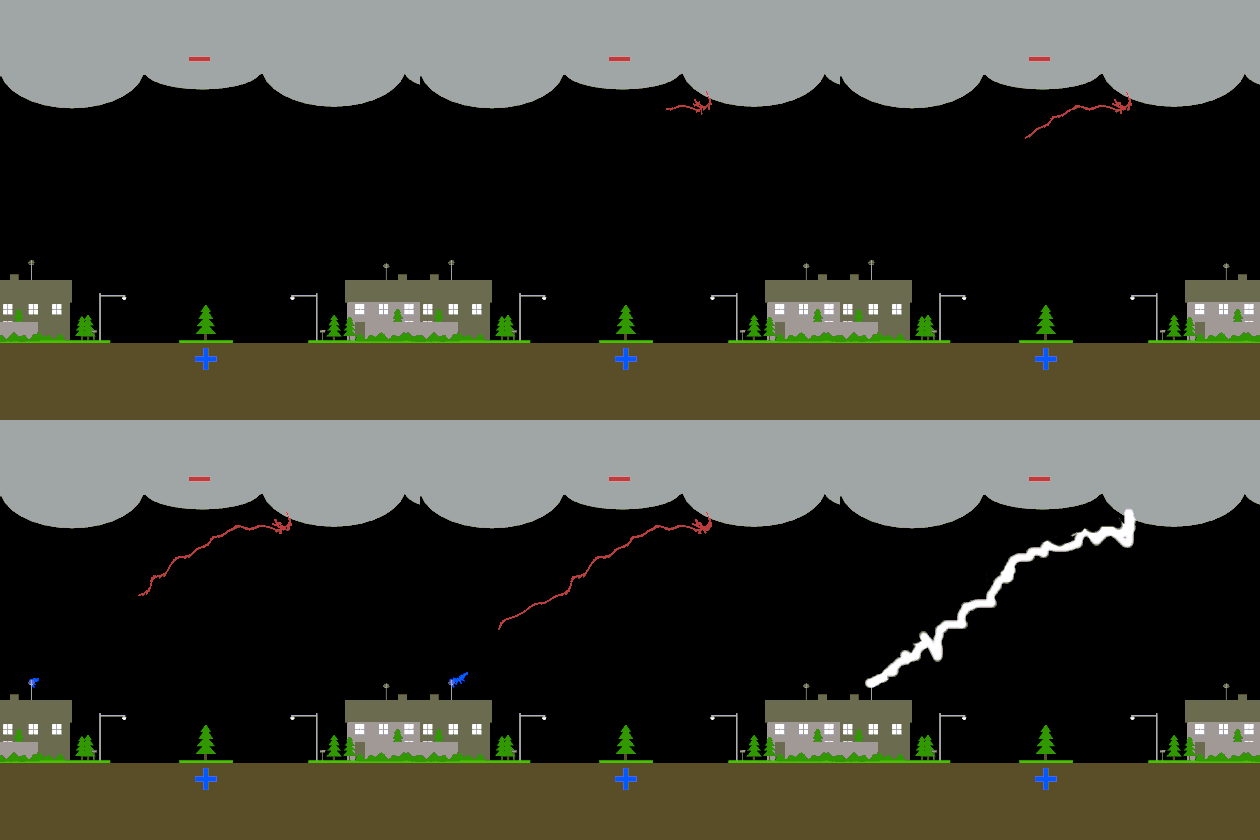
We were in that pool, saw/heard the storm coming, and decided to make a speedy exit from the water and sit on the back porch to watch the storm roll in. 15 minutes later and after 2 strikes that were a tad too close for comfort (complete with a humming that I interpreted as the sound being made by the electric fields, or more specifically, the positively-charged ionic channels of the positive, or upward streamers, that were developing off of our house and our trees), we went inside the house... No more than 30 seconds later, the trees by the pool were struck.

I, of course, was standing in front of a window that faces those trees: Hair on the arms went up (the upward streamers, this time being intensified as the negatively-charger leaders from the clouds approached, increasing the localized electric field strength), heard a distinct buzzing snap in my right ear (probably the corona discharge of the intensifying upward streamers), and saw the bolt strike (“attachment”, or the downward leader connecting with the upward leader causing the discharge, or “return stroke”).
Animation of connecting leaders forming lightning from Wikipedia.

The lightning traveled down all three trees, and into the ground, apparently following the root systems. One of those roots snakes toward the pool. The bolt traveled along it, blowing out the dirt above as it went, and slamming into the pool’s concrete apron, chipping and cracking it as it continued its journey into the pool itself.
From there, it must have followed the water lines, or maybe the wire to the underwater pool light, or maybe the grounding wires, right into the pool’s breaker box. So, what you see with the scouring of the trees are the flash-boiling of a tree’s cambium water by temperatures that can be upwards of 50,000 Kelvin, which exploded out the bark. 
The ground paths? Dug the same way… Steam explosions. In addition, as I live in a region with sandy soil, fulgurites were formed as the lightning’s plasma channel melted the sand. 

No clue what the polarity of the lightning was, but let’s assume it was of the predominate negative variety… The average bolt of negative lightning carries an electric current of 30,000 amperes (30 kA), and transfers 15 coulombs of electric charge and 500 megajoules of energy. Large bolts can carry up to 120 kA and 350 coulombs. Needless to say, the pool didn’t stop all of the lightning’s power… Some of the charge passed into the house. The fire alarm in the house went off… Fire department showed up, but no fire. Apparently the lightning shorted out the alarm’s fire detection system. As for other things being shorted out… Well, actually more like cooked, fried, and melted, the computerized salt regulator on the pool pump has gone to a better place.

And here’s a fun fact… Surge protectors can do nothing against the power of lightning. Even though every electronic toy in the house is plugged into a serge protector, damage did occur. Luckily, it was minor and localized to the bedroom that shares the wall with the pool’s breaker box. So, minus a dead Direct TV receiver and Blu-Ray player, and a damaged HDMI port on a TV, we were lucky. Even the pool pump survived (minus the salt regulator, of course).  Of course, breakers for the house were tripped, and required inspection by an electrician before flipping them back on. And, the alarm company had to be called back twice... In addition to replacing fire detection sensors, they had to replace other sensors, because over the course of a week, they began to short out, one by one, and the alarm system would go off every single time there was a storm.  Basically, the house turned into a lightning detector... Wonderful thing at 3 am.

But wait! There's more!!!

On 06 August, 19 days later, those same exact trees were stuck by lightning again. We were in the aforementioned bedroom watching the storm, looking dead at those trees when it struck...

This time, the lightning meant business. Forget going directly to ground. After scouring its way down the trees, it blew out of their trunks and slammed into the apron of the pool at the water’s edge in three places, shattering and exploding the stone.
Again, the charge traveled to the pool’s breaker box and into the house. However, as we had everything unplugged this time (you learn), there was no damage, with only main breakers of the house having to be reset (after inspection by another electrician, of course, who also did a sweep of the entire house this time and found nothing). And again, the pool pump survived the assault, but the pool itself clearly requires a bit of maintenance.
For both lighting strikes, I suspect the pool absorbed the bulk of the energy, literally saving the house. But that’s the thing… BOTH strikes? Obviously, there is some funny business going on in regards to where I live...

The neighborhood is situated on a hill, but my house it far from being at its highest point. However, the trees that keep being struck are probably some of the tallest in the area (well, one of them is). But, that still does not neatly account for this insanity. There has to be something under them that is making the spot so conducive to lightning strikes. I suspect that it is a combination of the elevation, the tall trees, high metal content in the underlying soil, and the wonderful conductor/grounder of the pool, that results in the place in which I chose to live being a spectacular natural abnormality. To make it even more daffy, I’d love to speculate that the meteor that hit the area 81 million years ago left a nice iron piece of itself which is not buried beneath by backyard… But that’s probably pushing it.

Then again, it’s not like this situation is believable to begin with…

I mean really… If that big tree in the center falls/when it is cut down (as it is most certainly dead… all three trees are dead and need to be removed), and I see a geode fall out of its roots… That’s it... I saw that movie. I am not sticking around to watch a bunch of little naked demons come crawling out of the hole.
©New Century Entertainment Corporation.

Of course, some would say that there has been at least one documentary about a haunted swimming pool, and Craig T. Nelson took care of it like a man. Well, I am less of a man than Craig T. Nelson... If that’s the case, I need a Tangina.
©MGM

Then again, we are situated on what used to be Indian land… And 5 minutes after the second strike occurred, there appeared a raccoon in one of the trees, and a hawk squawking overhead… Probably a good idea not to bury anything dead in the ground around here…
From Wikipedia.


If I was a suspicious man, I'd say it sure looks like something doesn't want us to live here... So much for the anecdote of lightning never striking the same place twice. We absolutely blow away the statistics.

Wednesday, August 5, 2015

Adv Tech Course: Banner Creation

Long story short, to create the banner for this blog I messed with using both MS PowerPoint© and Pixlr©.  In fact, I made simple banners in both, just to compare and contrast. But in the end, to make the "real" banner for the blog, I made an image in Pixelmator©, which is a graphics program like photoshop for Mac, and then added it to the banner template in PowerPoint© (since that was one of the two programs we were to use). Frankly, I would not use to PowerPoint© or Pixlr© create images for a course.

PowerPoint© is very limiting. You can make shapes, do simply coloring (most advanced you can get outside of presets are gradients), and import images.  Pixlr, by the simple fact that I need to make an account, or sign in with Facebook (which then wants to import my profile information so it can spam me), etc., is just inconvenient from the start, and slow depending on your web connection.  Yes, it has interesting effect presets and such, but I didn't find it user friendly, and it bothers me from a privacy standpoint that I am creating images online, especially since I like to use my own drawings (like I did here with my drawing of a Triceratops skull, complete with retro effect applied) or photographs in my graphics creations.

So in the end, I decided to, in a way, do what the course instructions for Pixlr suggested... Used more than one program to make my banner. I first use a graphics program that I am familiar with to make an image (text included), and then added that image to PowerPoint© to create the banner.  If in the future I decide to make images for a course, I'd just skip the PowerPoint© step and make the banner in its entirety in a graphics program (off line)... maybe to spice up lesson pages with banner titles, etc. The hardest part was getting the size right for the blog (so the entire image would show up correct). But once you figure out the size you need, the process is a snap.

And FYSA... Pixlr© can also be downloaded as an "extension" to Chrome.

Sunday, August 2, 2015

It's Simple Stupid

Image ©Panthera

It's simple stupid:

  • 100 years ago, there were an estimated 200,000 wild lions in Africa. They now number less than 35,000.
  • In the past 60 years alone, lion populations have reduced 95%, with an estimated continued loss of roughly 5 lions/day.
  • It is estimated that there are only about 3,000 mature male "trophy" lions left in the wild.
  • Lions now occupy only about 25% of their original geographic range.
  • As clearly depicted in the graphic, lions are being confined to isolated islands of habitat, which increases their risk of extinction.
  • Lions now only exist in 28 countries (27 in Africa, 1 in Asia), and out of those, only 7 countries - Botswana, Ethiopia, Kenya, South Africa, Tanzania, Zambia and Zimbabwe - are thought to each hold more than 1,000 lions.
  • The IUCN lists lions as "Vulnerable", while in West and Central Africa, they are classified as "Endangered"... Only 406 (273–605) lions remain in the whole of West Africa, representing less than 250 mature individuals occupying a range estimated at 49,000 km2, or 1.1% of their historical range (the West African Lion is genetically distinct from other African lions).

  • Severe climate variability (i.e. climate change-induced droughts) effects prey animal availability, and subsequently influences carnivore species ranging patterns: Wide-ranging species, like lions, are forced to leave protected areas such as parks and reserves in search of food… bringing them into conflict with humans.
  • Retaliatory killing (for livestock death) and habitat loss/environmental degradation play significant roles in the declining lion population.
  • Conservation strategies, such as compensation for livestock and drawing on local cultural values and knowledge to mitigate livestock-carnivore conflict can be extremely effective (87 – 99% drop in retaliatory killings where employed), as are programs where locals see tangible benefits for having carnivores on village land.

  • But the science is clear about hunting: There is no conservation benefit. Lions decline in number where they are hunted.
  • At least 7 African countries allow lion hunting: On average, 500 lions/year are shot for sport, with about 80% of their heads and skins shipped back to the U.S.
  • When one mature male "trophy" lion is killed, many other lions could die along with it: Adult male lions normally form coalitions, with 2 controlling a pride (about 8 females with up to 20 or so cubs at any one time) and associated territory. When one dies, the surviving male is left vulnerable to wandering males looking for prides/territories of their own. These marauders will oust the remaining ruling male, and then kill all the immature offspring (i.e. the cubs, and the adolescent males who aren't driven away).

  • Legal lion hunting has no economic value.
  • A typical legal lion hunting operation employs under 15 people. The sum total contribution of all legal lion hunting to a typical country's GDP is much less than 0.5%.
  • Photographic tourism, on the other hand, is extremely lucrative. In one particular country's reserve alone, nearly 200 people are employed, and the increase in government revenue over that of legal hunting is over 1,300%.

  • If trends continue, depending on what report you read, African lions could essentially be extinct in the wild before 2100, which will result in biodiversity perturbations causing the extinction of other species.

Again... It's simple stupid.


References:

Wednesday, July 29, 2015

No worries here... I'm just walking on by, nothing to be afraid of...


Picture this picture... A stereotypical image of prehistory I am certain you've seen before... A wide-open flood plain (mountains and trees in the far distance) being traversed by a herd of Alamosaurus (sauropods) that are being attacked by a marauding flock of Tyrannosaurs rex. Although many usually find such images and the stories of what they depict to be the awesomest thing they had ever seen / read, my opinion is a bit different. For the sake of posterity, here's why...

We tend to underestimate these animals, probably in favor of the fantastic battles of the movies and of the books we grew up with... Exactly like that described above. As with other "super sauropod killers", such as Giganotosaurus, these "Southern Rexes" were most likely sauropod specialists (same applies for the "Northern Rexes" that were hunting ceratopsians, hadrosaurs, etc.)... In other words, given the levels of risk involved, they surely knew exactly where to deliver precise, crippling blows to quickly dispatch large, dangerous prey animals, minimizing their own exposure to injury and / or death. We should be suspicious of scenarios having prolonged battles (the mammalian bias) and sit downs (the Komodo Dragon bias), or which insinuate a tactic of full-hearty volleys that place predators who are on the losing end of a size disparity in compromised positions. Therefore, such pictures as described above, although often wonderful pieces of Paleo art accompanied by exhilarating stories, are probably unrealistic / fantastical in their representation of an actual hunt. In fact, the Chased by Dinosaurs episode with Giganotosaurus and Argentinosaurus, and The Ballad of Big Al and its salt flat attack scene
 are perfect examples of such unlikely scenarios.

[Insert here, a defensive comment from the artist / author about how animals will risk life and limb to avoid "dying from hunger".]

Meh... Does every attack always have to be a desperate, dramatic, "dying from hunger" scenario? For a barely semi-legitimate comparison's sake, consider lions and elephants in this study: Joubert D. 2006. Hunting behaviour of lions (Panthera leo) on elephants (Loxodonta africana) in the Chobe National Park, Botswana. Afr J Ecol 44:279-281. Bottomline is that lions are rather careful about attacking something so much larger than themselves (and I'm sure there is a "dying from hunger" scenario in there someplace, as failed attempts don't do much in the way of fulfilling a lion's energy requirements). Basically, lions employ a similar tactic as used on other large prey animals (think cape buffalo), where attacks are AMBUSH attacks (i.e not exposed out in the open) from the rear of the selected elephant, the majority of which are subadult animals (younger still have attentive adults, and I imagine smaller animals are easier to handle, in general). In that same vein, maximum non-visibility is a factor, especially if adult animals are targeted, as a fair number of such attacks in the study occurred during low-light hours (all but 1 attack on an adult was at dusk / night... the adult attacked during the day was suffering from an injury received during a fight with another adult elephant).


During an attack, lions position themselves at the furthest possible place away from an elephant's defenses. The usual modus operandi is to target herd stragglers (nearly half killed in the study were some 50 m away from the main herd), but if not, a tactic of panic is employed to bunch elephants in an effort to apparently make them cause injury to themselves (i.e. cause one to fall, get crushed, etc.). And that's about where a comparison of big mammal - big dinosaur tactics ends, because a theropod who held on to a sauropod (or a ceratopsian, etc.), was a dead theropod. As for success rate and assessment of risk to the lions... Over the course of 4 years and 323 attempts, only 74 were successful kills, with only 1 lion being seriously injured... and that injury was accidental, rather than a result of a defensive move on behalf of the elephant (the elephant fell the wrong way, landing on top of a lion, which apparently survived the initial injury, at least). Unfortunately, the study doesn't specify how many lions were usually involved in an attack.

So, the lesson here is that, cautious, low-risk predation tactics is the order of the day when it comes to the interaction between two of today's largest terrestrial animals, and this most likely applied to our beloved extinct titans as well.

Ballad of Big Al salt flat attack scene


Image on the left: ©Gregory S. Paul.    Image on the right: ©Damir G. Martin.